

Neodymium Magnets: The Most Powerful Magnets on the Market
Neodymium magnets, also known as NdFeB magnets, are recognized as the most powerful permanent magnets available on the market. They are made from an alloy of neodymium, iron, and boron, where neodymium — a rare-earth metal — provides exceptional magnetic properties. Thanks to this combination, these magnets offer remarkable strength even in very small formats, making them indispensable in numerous industrial and technological applications.
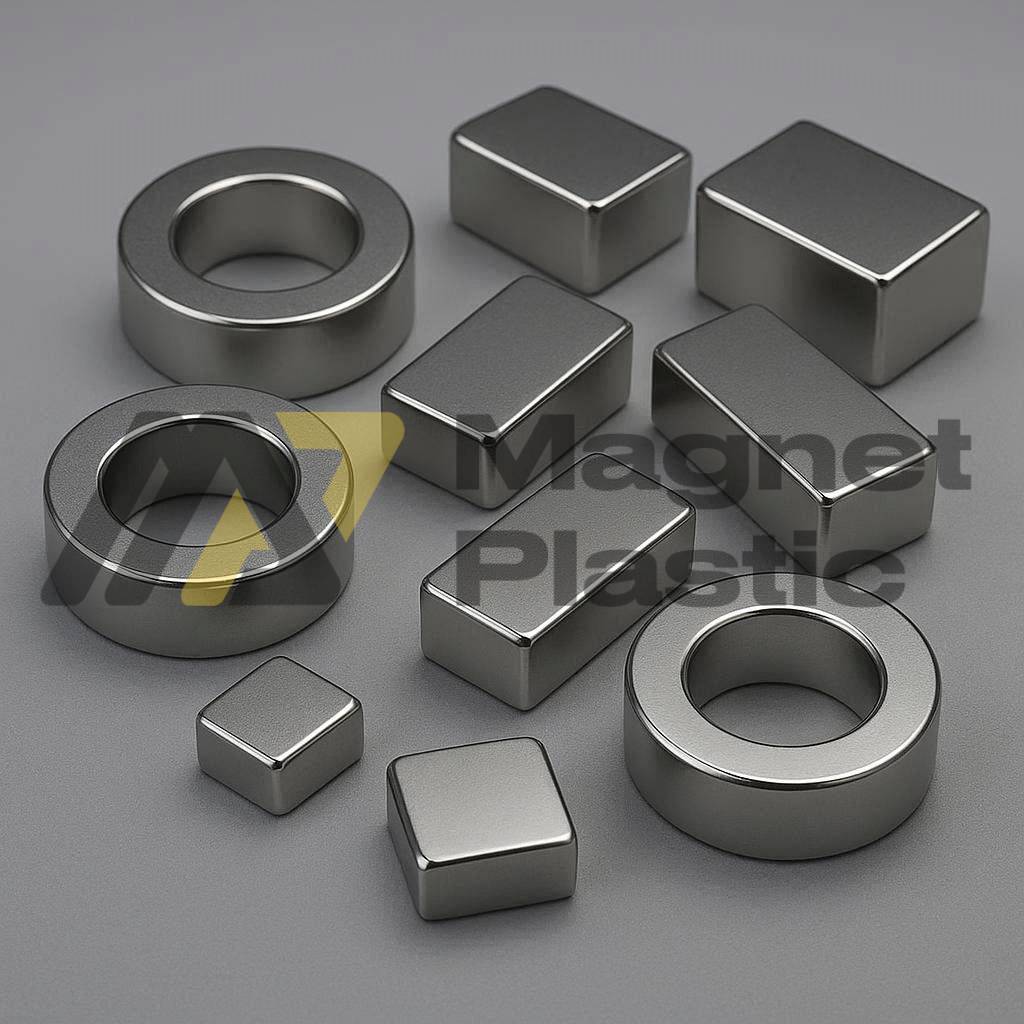
One of their main advantages is their strong magnetic field and high coercivity, ensuring magnetic stability against external influences. However, they do have some limitations: their Curie temperature is relatively low, they are sensitive to oxidation and corrosion, and they are brittle due to their crystalline structure. To compensate for these drawbacks, neodymium magnets are generally protected with coatings such as plastic, rubber, nickel, zinc, or other metallic or polymer layers. They are available in a wide range of shapes — discs, blocks, rings — and can include accessories such as through-holes, threads, hooks, or adhesive surfaces.
Uses and Applications of Neodymium Magnets
The versatility of these magnets allows them to be used in many sectors. In the furniture and construction industries, they are used for magnetic closures, removable panels, and fastening systems. In the automotive sector, they are essential for sensors, electric motors, and safety devices. They are also found in lighting systems, the plastics and metallurgy industries, as well as in the food industry, where they help recover metal particles on production lines.
Many modern electronic devices rely on these magnets: mobile phones, hard drives, earphones, speakers, and microphones use neodymium magnets to enhance performance. They are also essential in motors, turbines, generators, and pumps, where their efficiency helps optimize energy consumption. Other applications include magnetic levitation, medical devices, magnetic therapy, magnet fishing, model making, and DIY projects.
Despite their power, neodymium magnets are more expensive than ferrite magnets. Even standard grades like N35 far exceed conventional magnets in terms of performance and price. This is mainly due to the high cost of raw materials: rare-earth elements account for between 80% and 98% of the total cost of the magnet, while they make up only about 30% of its weight.
Grades, Coatings, and Thermal Resistance
The grade of a neodymium magnet — indicated by the letter N followed by a number — corresponds to its magnetic strength. The higher the number, the more powerful the magnet. For example, a small N45 disc measuring 3 × 2 mm provides a pull force of 0.18 kg, while an N48 reaches 0.25 kg, representing a 39% increase.
Available coatings include nickel, zinc, gold, epoxy, as well as plastic or rubber coatings. Some only modify appearance, while others significantly improve resistance to corrosion or impacts.
Regarding temperature, standard neodymium magnets withstand up to 80°C, but some versions can endure up to 200°C thanks to special alloys. The acronyms M, H, SH, UH, EH, and TH indicate the maximum allowable temperature, ranging from 100°C for M grades to 220°C for TH grades.