

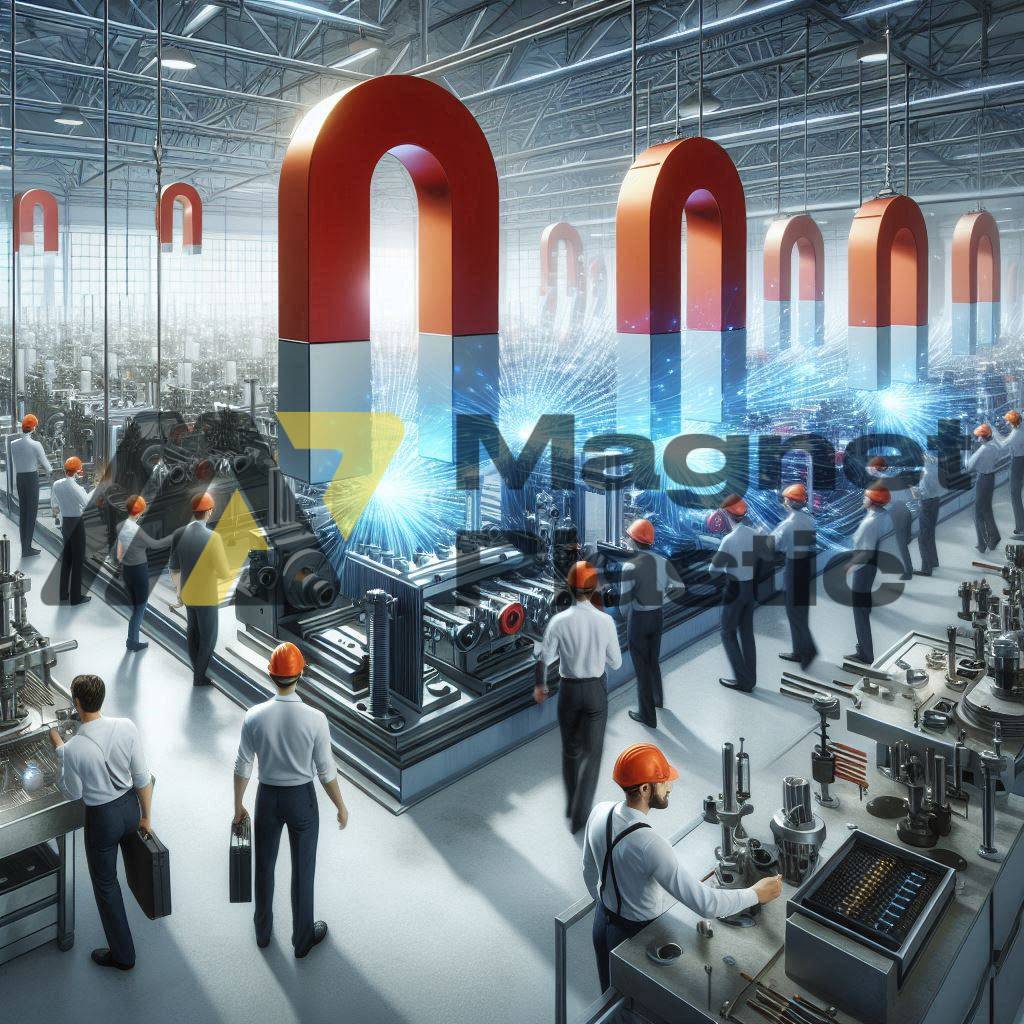
The Transformative Role of Magnetism in Modern Industry
Magnetism is not only useful for levitation or electricity generation. In modern industry, magnetic systems are revolutionizing the way materials are manufactured, transported, controlled, and recycled. From car production to recycling plants, magnets enable faster, safer, and more efficient processes, becoming essential technology for 21st-century industrial automation.
Material Transport and Handling
One of the most visible uses of magnetism in industry is the transport and handling of heavy objects. Magnetic cranes lift large steel or iron components without direct contact, significantly reducing workplace accidents. Likewise, magnetic conveyors ensure the continuous movement of metal parts in factories and warehouses, improving production-line efficiency.
In automated environments, robots equipped with magnetic grippers or suction systems perform assembly and logistics tasks with high precision. Operating without friction or mechanical contact, these systems reduce component wear and provide more stable and accurate motion control.
Magnetic Separation and Sorting
In sectors such as mining, recycling, and food processing, magnetic separation systems have become indispensable. Ferrous metal separators allow fast, cost-effective sorting and recovery of scrap materials. In chemical and pharmaceutical industries, magnetic filters remove unwanted particles that could compromise product quality or damage machinery. Magnetism therefore plays a crucial role in preserving process purity and extending equipment lifespan.
Contact-Free Coupling and Fastening
Magnetic coupling and fastening systems represent another major application. In motors, pumps, and generators, magnetic couplings transmit motion without physical contact, eliminating leaks, vibration, and frequent maintenance. On assembly lines, magnetic fasteners speed up the attachment and removal of parts, enhancing flexibility and safety in highly automated environments.
Magnetic Sensors and Control
Industrial process control also benefits from magnetic technologies. Sensors capable of measuring position, speed, force, or direction without mechanical contact enable precise, reliable automation. Magnetic encoders, proximity detectors, and automatic control systems are essential in robotics, high-speed machinery, and digital production environments.
Applications in Energy and Motors
Modern motors and generators rely heavily on magnetism. Brushless motors—widely used in electric vehicles—offer greater energy efficiency and require less maintenance because they eliminate traditional brushes. In renewable energy systems, turbines and generators use advanced magnets to produce electricity more stably and efficiently.
Recent Innovations
The industry continues to advance with cutting-edge magnetic technologies: contact-free magnetic bearings for high-speed and low-friction applications, magnetic levitation systems for internal material transport, and hybrid control systems combining permanent magnets, electromagnets, and superconductors for extreme precision and stability.
Conclusion
Magnetic systems not only simplify industrial operations; they also boost productivity, safety, and energy efficiency. The integration of advanced magnets, intelligent sensors, and superconducting technologies is transforming factories, recycling centers, and assembly lines—bringing us closer to a cleaner, smarter, and fully automated industrial future.