

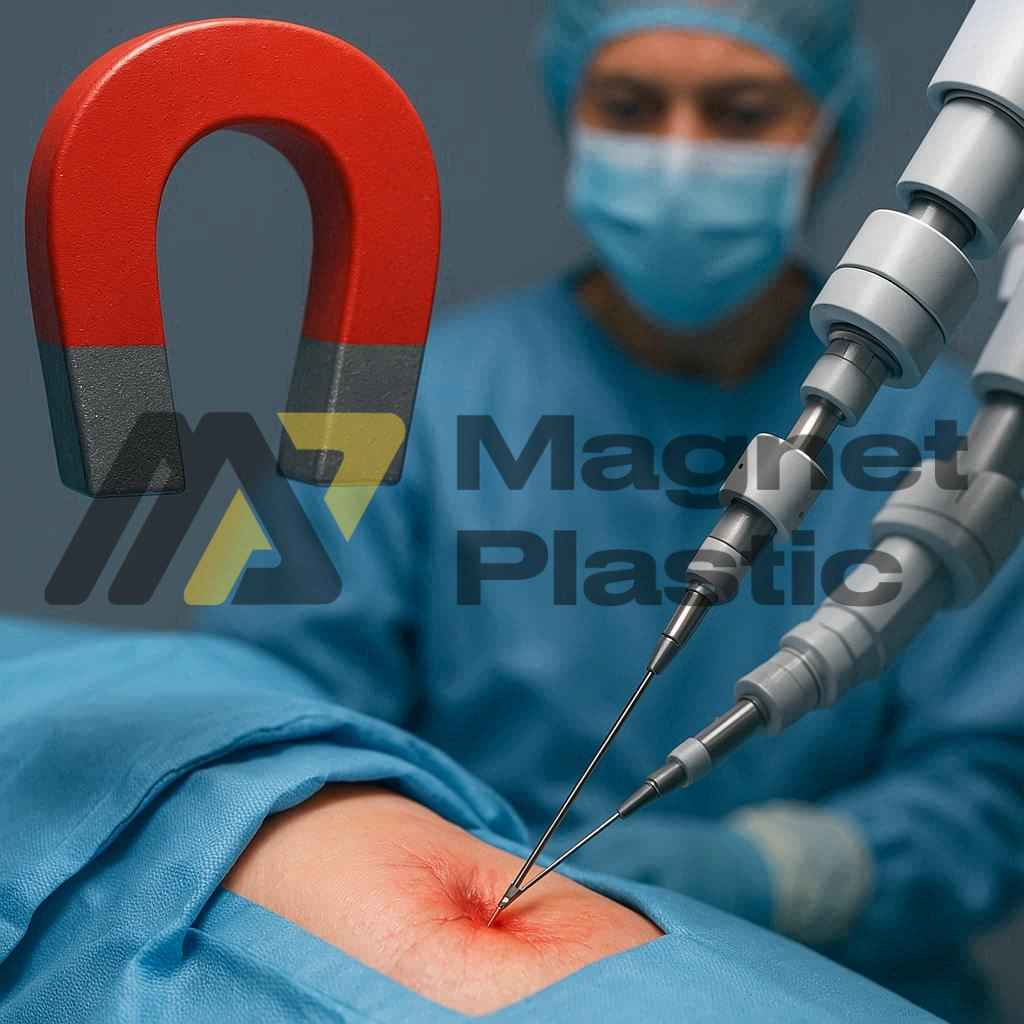
Magnets and Medical Robotics: Precision in Microsurgeries and Internal Treatments
21st-century medicine is undergoing a profound transformation thanks to the convergence of robotics, artificial intelligence, and magnetic technologies. In this context, externally controlled micro-magnets are emerging as a revolutionary tool in minimally invasive surgery, enabling interventions with unparalleled precision inside the human body.
These systems combine medical robotics with highly precise magnetic fields to manipulate surgical instruments or micro-devices without the need for large incisions. Instead of using traditional scalpels or robotic arms, the surgeon can guide small magnets or magnetic capsules through an external magnetic field, achieving smooth, precise, and safe movements in anatomically difficult-to-reach areas.
How Micro-Magnets Work in Surgery
The principle is as simple as it is ingenious. An external magnetic field, generated by a control system—often robotic and computer-assisted—directs the orientation and movement of a micro-magnet or nanodevice inside the body. These micro-magnets can be coupled with cameras, sensors, or micro-surgical tools. By adjusting the polarity or intensity of the field, the surgeon can move them with millimeter precision, even within delicate organs such as the brain, heart, or digestive system.
One of the most promising applications is gastrointestinal microsurgery using ingestible magnetic capsules. Equipped with cameras and controlled externally, these capsules allow internal exploration without invasive intervention. In the future, they could even deliver drugs or perform micro-interventions directly on affected areas.
Significant Advantages Over Traditional Surgery
The use of remotely controlled magnets offers numerous benefits:
- Less invasiveness and risk: Incisions are minimized, reducing bleeding, infections, and recovery times.
- Enhanced precision: Robotic systems allow extremely fine movements that are impossible to perform manually.
- Multiple applications: Stent placement, tissue repair, targeted drug delivery, or localized tumor destruction.
Moreover, these technologies reduce patient exposure to radiation by combining magnetic guidance with imaging obtained via MRI or ultrasound.
Technological and Ethical Challenges
However, implementing magnetic medical robotics still faces several challenges. Designing biocompatible micro-magnets, precisely calibrating magnetic fields, and integrating them with high-resolution imaging systems require cutting-edge engineering. Additionally, remotely controlling objects inside the human body raises ethical and safety concerns, particularly regarding system autonomy and medical data protection.
Towards a Future of Absolute Precision
The development of externally controlled micro-magnets represents a new frontier for surgery and personalized medicine. Current advances point to a future where magnetic robots could navigate inside the body as “invisible surgeons,” capable of diagnosing, repairing, and treating with microscopic precision.
Thus, the combination of magnets, robotics, and artificial intelligence promises to transform the very notion of medical intervention, bringing science fiction ever closer to clinical reality.