

Magnets in the Manufacturing of LED Displays
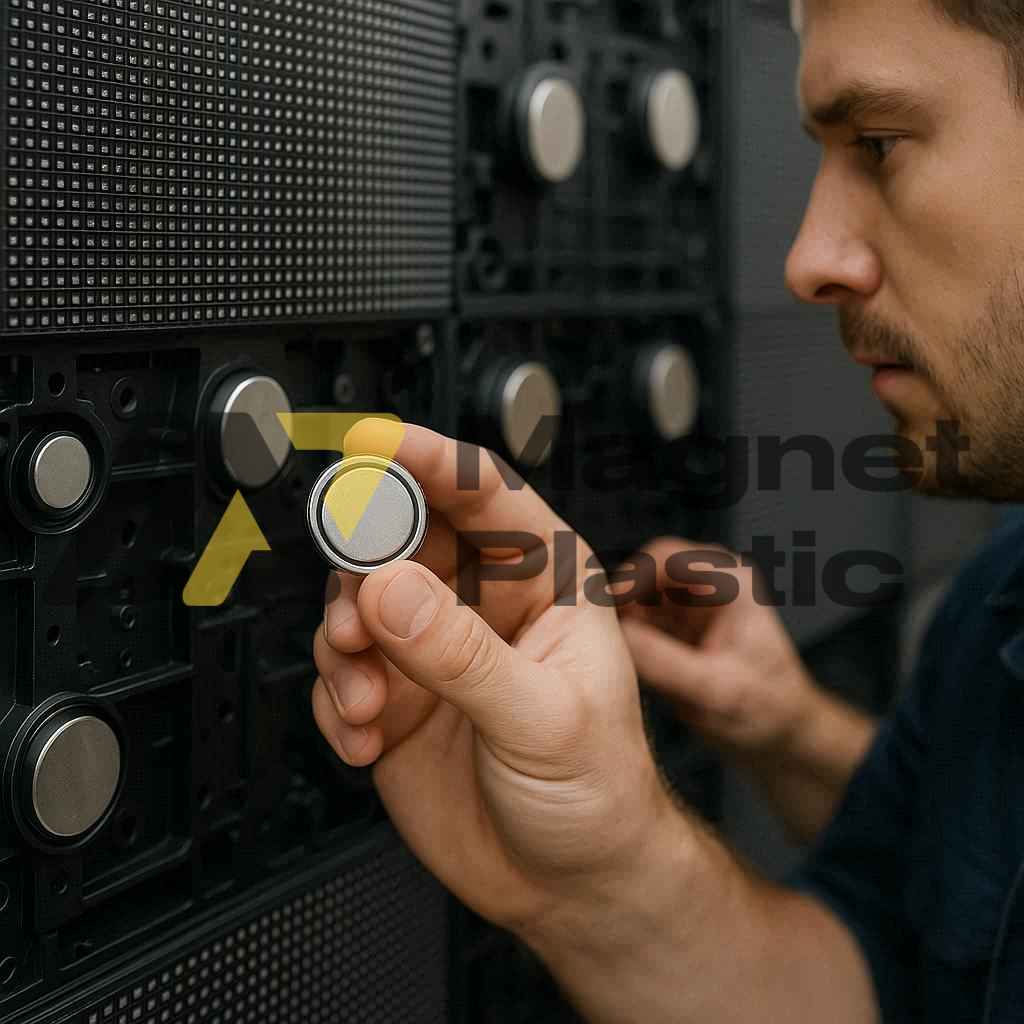
LED displays have become an essential tool in modern visual communication, whether at sporting events, concerts, or large-scale advertising. Behind their flawless performance and versatile design lies a key but often overlooked technology: magnets. Yes, magnets are commonly used in the manufacturing and assembly of LED displays, particularly in front-access systems and for module installation.
They allow faster and safer assembly, while simplifying maintenance since modules can be removed magnetically without the need for complex tools. During production, high-precision magnets, especially neodymium (NdFeB) magnets, ensure a perfect fit between display components, guaranteeing both performance and durability.
Specific Uses of Magnets in LED Displays
- Module mounting: magnets firmly attach LED modules to the display structure, reducing installation time and making assembly/disassembly faster.
- Front-access and flexible displays: in modern designs where maintenance must be carried out from the front, magnets offer a practical and efficient solution.
- Magnetic connection systems: some systems use magnets to connect display plates to their cabinets, improving both speed and assembly quality.
- High-precision manufacturing: neodymium magnets ensure exact alignment of components, enhancing stability and performance.
Innovations in Magnet Design for LED Displays
Mounting magnets, often encased in steel housings, optimize the magnetic circuit, protect the magnet from damage, and provide significant holding force. This magnetic adhesion can replace traditional fastening methods such as screws or bolts, giving designers more flexibility.
The development of new shapes — circular, cylindrical, spherical, or countersunk — addresses the structural demands of large LED displays. For example:
- Countersunk magnets fit seamlessly into frames for discreet yet strong mounting.
- Cylindrical magnets provide stable vertical connections between display modules.
Threaded, adjustable magnets have also been developed, allowing fine adjustments in height or angle during installation. This innovation ensures greater precision, reduces errors, and improves overall efficiency.
Resistance and Durability in Challenging Environments
Large LED displays often face extreme conditions: heat, humidity, dust, or vibrations. NdFeB magnets have therefore been enhanced to resist corrosion and maintain their magnetic properties over the long term. They ensure stable operation outdoors and in critical environments such as stadiums, concerts, or large public events.
High-precision manufacturing techniques — cutting, polishing, and drilling — are widely used to produce magnets that meet strict dimensional tolerances, ensuring perfect fit with other components and reliable performance.
Conclusion
Magnets, though small and discreet, are essential components in the success of modern LED displays. Their strength, precision, and adaptability make them indispensable for quick installation, simplified maintenance, and long-term reliability.
At MagnetPlastic, we are proud to contribute to innovative projects by offering our expertise in material selection, design optimization, and the supply of advanced magnetic solutions. Our mission is clear: to provide the best magnets for new technologies and ensure every LED display meets the highest standards of quality and performance.